
The Complete Guide to Natural Gas Transport Optimization in Alberta’s NGTL System.
Natural gas transport is the contractual right to move gas through pipeline systems. In Alberta, many producers and shippers hold firm capacity (receipt or delivery) that is impacted by imbalances due to production variability, seasonal swings, and company-specific reasons.
The associated costs to these imbalances could be significantly higher — but it also creates major opportunities. Through secondary markets and modern digital platforms like Hummingbird by TOTEC Solutions, shippers can reduce costs.
What You’ll Learn in This Guide
How firm contracts actually work
Firm vs. Interruptible transport
Imbalances
How traditional secondary markets operate
The rise of digital marketplaces
Practical steps to optimize your firm contracts
The future of gas transportations and logistics in Alberta and North America
1. What Is Natural Gas Transport?
Natural gas transport is the contractual right to move a specific volume of natural gas through a pipeline system over a defined period.
Key Concepts:
Measured in e3m3/day (“cubes” per day) for producers, GJ/day (Gigajoules per day) for demand users like utilities or large industrials or MMcf/day for USA based activites.
Tied to specific receipt points (where gas enters the pipeline) and delivery points
Granted through long-term contracts with pipeline operators (e.g., TC Energy’s NGTL system - Read Full Disclaimer)
Can be firm (guaranteed) or interruptible (as-available)
Firm contracts give shippers priority access but also create financial obligations even when the firm contracts are not balanced against production.
2. Firm vs Interruptible Capacity

Most inefficiencies come from over-contracted firm capacity. Producers lock in firm contracts for peak production periods but end up paying for firm contracts during lower-production months
3. Imbalances
Imbalances arise when firm contract transportation doesn’t match actual gas flows.
Main Causes:
Production variability – Output fluctuates due to well performance, maintenance, or market conditions
Seasonal demand swings – High winter demand vs. lower summer volumes
Infrastructure constraints at receipt or delivery points
Result: Shippers pay reservation charges for firm contracts they don’t need.
Financial Impact:
Direct monthly cost with zero return
Reduced overall asset efficiency
Missed opportunity to reduce costs in the secondary market
4. How Secondary Markets Operate
Secondary markets allow shippers to temporarily sell, release, or assign their firm contracts to other parties.
Traditional Secondary Market Model:
Bilateral (one-to-one) deals
Negotiated via phone, email, or personal networks
Limited visibility and opaque pricing
Slow execution (often days or weeks)
Heavy reliance on relationships
5. The Rise of Digital Marketplaces
A digital transportation marketplace is a digital platform that brings buyers and sellers of transport firm contracts together in one structured environment in a secondary market.
Key Benefits:
Monetization of firm contracts
Lower-cost access for buyers needing short-term firm transport
Real-time pricing driven by supply and demand
Increased system-wide efficiency
Faster, transparent, and auditable transactions
Hummingbird by TOTEC is purpose-built for the NGTL system — helping shippers automatically identify available firm contracts in the secondary market
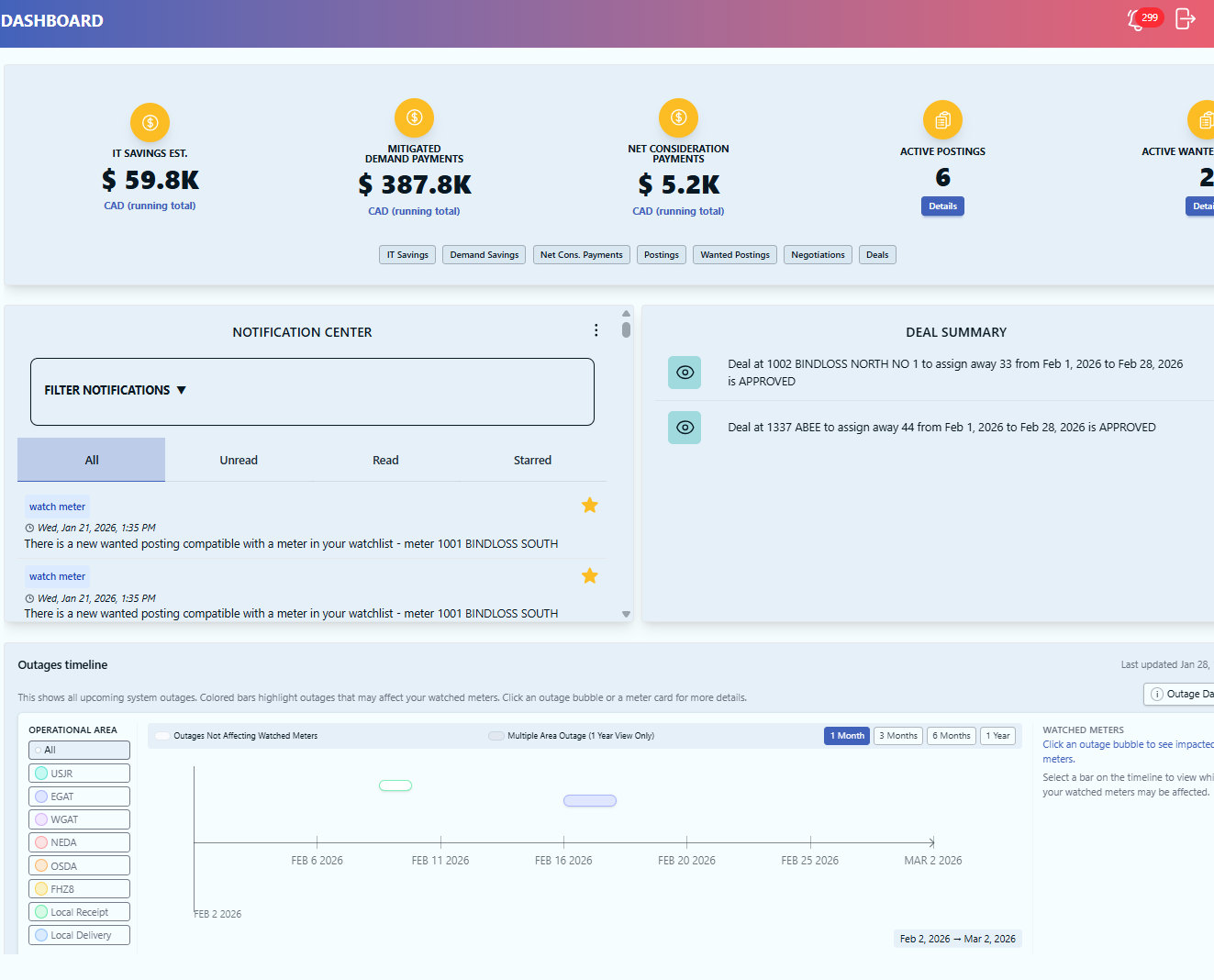
Hummingbird - Main Dashboard
6. How to Optimize Natural Gas Transport Costs
Effective optimization requires moving from passive contract management to active optimization
Practical Steps:
Monitor daily and monthly firm contracts
Identify firm contracts availability in real time
Price your firm contracts competitively based on market conditions
List and execute trades quickly through Hummingbird marketplace
Track savings, and utilization with live dashboards
Shippers using modern platforms like Hummingbird typically recover 15–30% of transportation costs and could generate additional revenue from their existing firm contracts.
7. NGTL System Overview
The NGTL (NOVA Gas Transmission Ltd. Read Full Disclaimer) system is one of the largest natural gas gathering and transmission networks in North America with over 25000 kms of pipeline, serving producers across Alberta and parts of British Columbia.
Key Characteristics:
Extensive pipeline network with hundreds of receipt and delivery points
Heavy reliance on long-term firm contracts
Significant seasonal and locational capacity imbalances
Active but fragmented secondary market
NGTL shippers face unique challenges — and equally large opportunities — due to the scale and dynamics of the Western Canadian Sedimentary Basin.
8. The Future of Gas Transport: From Contracts to Markets
The industry is shifting from static, long-term contracts to dynamic, market-driven optimization.
Digital platforms, real-time data, and structured marketplaces are enabling shippers to treat firm contracts as a flexible asset rather than a fixed cost. This transition improves efficiency for producers and increases overall pipeline utilization across North America.
Frequently Asked Questions (FAQ)
What is NGTL Firm Contract? NGTL firm contracts refers to transport rights on the NOVA Gas Transmission Ltd. pipeline system in Western Canada.
Why firm contracts experience imbalances? Because production levels fluctuate while long-term transport contracts remain fixed, especially with seasonal demand swings.
What is stranded firm contract? Firm contract that is paid for but neither used nor monetized, resulting in direct financial loss.
How can firm contracts be monetized? By selling or temporarily releasing it through secondary markets or modern digital platforms like Hummingbird.
What is the difference between firm and interruptible service? Firm service guarantees transport rights at a specific cost based on the time period of the contracts, while interruptible service carries a premium and can be curtailed when the system is constrained.
Ready to stop leaving money on the table?
Discover how Hummingbird by TOTEC can help you identify, monetize, and optimize your NGTL firm contracts
→ Learn more about Transport Capacity in NGTL System